

Enterprise Orchestration Layer: Why AI Is Really About Organisation Design

Updated: Sep 29
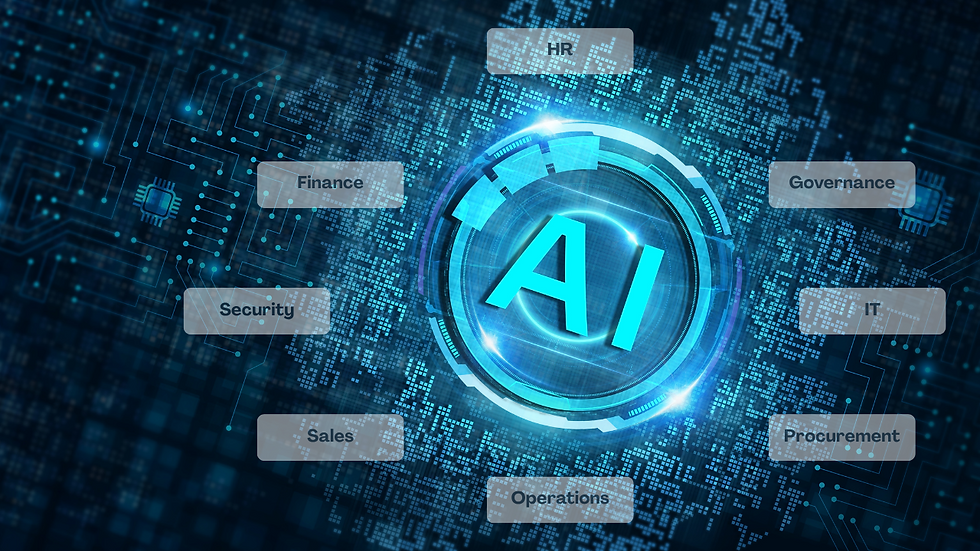
For the past two years, much of the conversations around enterprise AI has centred on models, agentic AI and an ever-growing ecosystem of AI applications. Every major software vendor is either creating new AI product suites, or embedding AI into its products. While startups continue to develop specialised solutions for almost every business function imaginable.
This is both expected and necessary. Every technology wave begins with experimentation. Organisations discover new use cases, vendors compete to deliver new capabilities and the market gradually learns where the technology creates sustainable true value.
Yet history suggests that enterprise technology rarely creates lasting competitive advantage through applications alone. The technologies that fundamentally transformed organisations did something far more important. They changed how organisations operated.
I believe enterprise AI may be approaching that same inflection point.
The next phase of enterprise AI is defined by how organisations redesign their operating models around AI.
The Lesson From Enterprise Resource Planning Systems (ERP)
If we look back to the genesis of ERP, it did not become indispensable because it introduced accounting, procurement, or inventory management. These capabilities had existed in standalone systems before.
The problem the ERP solved was organisational fragmentation by establishing a common operating backbone. It standardised processes, integrated information, and enabled work to flow across functional boundaries instead of being trapped in silos.
The greatest value that ERP brought was organisational integration and that is why ERP project are rarely just technology implementations. There was a lot of redesigned processes, redefined ownership, data harmonisations, and alignment of business units around common ways of working. The software only delivered value because the organisation transformed alongside the implementation.
This is the parallel we see in Enterprise AI
AI Is Solving a Different Problem
The first generation of enterprise AI has largely focused on improving individual productivity. AI drafts reports, summarises meetings, analyses documents, and assists knowledge workers across business functions. These capabilities are already delivering measurable productivity gains, and will continue to improve as models become more capable.
However, most organisations are not constrained by how fast their employees write emails, but how work moves across the various functions.
Business processes span multiple departments, applications and decision makers. Information exists across ERP systems, CRM platforms, collaboration tools, document repositories and industry-specific software. Every handoff introduces delays, and every approval creates friction. Every exception requires coordination.
The bottleneck has elevated from information to coordinating work. And this is where I believe the next phase of enterprise AI begins.
Rather than adding another AI application, organisations now have to look to AI to coordinate work across existing enterprise systems. The applications remain and what changes is how work flows between them.
Consider something as familiar as customer onboarding. Once a contract is signed, work immediately spreads across the organisation. Sales updates the CRM, Compliance performs regulatory checks, Finance establishes billing accounts, Operations prepares implementation, all while Customer Success plans onboarding.
Each team performs its responsibilities effectively, information moving through the respective systems. Yet, someone still has to coordinate the entire process.
Today's AI application improves individual tasks, an enterprise orchestration layer changes something much more fundamental. Instead of optimising individual activities, AI understands the broader workflows. It retrieves information across systems, determines critical paths and key dependencies, invokes specialised AI agents where appropriate, and escalates decisions requiring human judgement. Thus, changing the end-to-end value chain.
The Real Challenge is Organisational, Not Technical
ERP taught us this once already, that the software was never the hard part. So, technology alone is not sufficient to drive transformative organisational changes.
In fact, technology is advancing faster than organisations themselves, and most enterprises already have the tools and systems at their disposal. The gap therefore lies in the organisational maturity required to orchestrate work at scale.
Data must be interoperable rather than simply available
Business processes need to be understood before they can be coordinated.
Governance must clearly define where AI can act autonomously, and where human intervention remains mandatory.
Decision rights need to be explicit rather than assumed
Trust Is The Cornerstone Of Enterprise AI Adoption
Perhaps most importantly, organisations need to trust AI sufficiently to embed it within daily operations. Trust is often discussed in terms of model accuracy, hallucinations or explainability. While these remain important, organisational trust extends much further.
Every time enterprises are convinced that AI is ready for greater autonomy, another high-profile failure reminds us that capability and trust are not the same thing. Hallucinated legal citations, incorrect financial analysis or autonomous agents making unintended changes reinforce a simple reality. Organisations do not adopt AI simply because it becomes more capable. They adopt AI when they have sufficient confidence that the technology, governance, and operating model together produce outcomes they can rely upon, and trust.
Trust is therefore built progressively. Most organisations will readily trust AI to execute non-critical tasks such as draft an email or summarise a meeting. Far fewer will immediately trust AI to approve multi-million dollar procurement requests, or make a regulatory decision without human in the loop.
And this naturally lead to one of the most important organisational questions of the AI era. While rsponsibility can be increasingly delegated, accountability cannot. Especially if AI goes amok and cause irreparable damage.
As AI assumes greater responsibility, leaders will need to rethink not only business processes, but also decision rights, governance structures, and escalation pathways. Organisations have spent decades refining how they onboard employees, assign identities and access privileges, and govern human behaviour.
AI agents introduce an entirely different challenge. Operating across enterprise applications and workflows, they are far less visible than their human counterparts, making identity management, governance, observability and oversight significantly more complex.
The Next Competitive Advantage
Every technology cycle eventually reaches a point where competitive advantage shifts. Initially, the value may come from adopting new technology, but as access proliferates and becomes a level playing field, the competitive advantage shifts from the tool to the skill of the wielder.
The ultimate competitive advantage comes from how organisations derive value from the technology. I believe enterprise AI is approaching that transition.
Models will improve and AI applications will become more capable. New agents and use cases will continue to emerge. Technology will always continue to evolve, often at a pace that outstrips an organisation’s ability to absorb and operationalise it.
Ironically, this relentless pace of innovation creates a paradox. Every breakthrough makes the case for adoption stronger, yet at the same time encourages organisations to wait for the next, presumably better, model, framework or architectural approach. The result is a form of options paralysis. Invest too early and today’s solution may be overtaken by tomorrow’s innovation. Wait too long and the organisation risks falling behind while competitors build the experience, operating models and institutional knowledge that cannot simply be acquired overnight.
However, the reality is that while technology evolves in months, organisations evolve in years. Redesigning operating models, strengthening governance, building trust, redefining decision rights and embedding new ways of working cannot happen at the pace of model releases.
Waiting for AI to “stabilise” before acting may therefore be waiting for a moment that never truly arrives.
Perhaps that is where the next competitive advantage will emerge. It will not necessarily belong to the organisation with the most advanced model or the largest number of AI applications. It will belong to the organisation that can continuously adapt its operating model while the technology continues to evolve.
Like every transformative technology before it, AI is ultimately a tool. Its impact will depend not on the capability of the technology alone, but on the capability of the organisation that wields it.
The similarity between ERP and Enterprise AI is organisational. Just as ERP required organisations to rethink how information move across the enterprise, AI will require organisations to rethink how work, decisions, and trust are distributed across people, systems, and AI agents.
AI's ERP moment therefore is not because AI replaces ERP, but AI becoming the next catalyst for the next evolution of the enterprise operating model.

